Corporate Taxes in Vietnam for Foreign Companies: CIT, VAT & Business License Tax (2026)

A foreign company that opens a Vietnamese subsidiary in 2026 picks up tax tasks almost immediately. There is a tax code to register, VAT invoices to issue, a provisional payment due by the 30th of the month after each quarter, and a withholding calculation every time an overseas consultant gets paid. The annual business license fee that used to arrive every January is the one chore that has disappeared, because Vietnam abolished it from 1 January 2026.
Corporate taxes in Vietnam for foreign companies come down to four main obligations:
- Corporate income tax (CIT) on profit
- Value-added tax (VAT) on sales
- Foreign contractor tax (FCT) on certain payments to overseas providers
- Personal income tax (PIT) withheld from staff salaries
This guide walks through each one, the rates that apply this year, the deadlines worth putting in a calendar, and how your choice of legal structure changes the bill.
How Corporate Income Tax Works in Vietnam

Corporate income tax is charged on company profit. The CIT Law (Law No. 67/2025/QH15) took effect on 1 October 2025 and applies from the 2025 tax year. The standard rate remains 20%, while oil, gas and certain mineral projects pay between 25% and 50%. The new law added two lower bands for smaller companies, which depend on annual revenue.
| Annual Revenue | CIT Rate |
|---|---|
| Up to VND 3 billion (about USD 115,000) | 15% |
| VND 3 billion to VND 50 billion (about USD 1.9 million) | 17% |
| Above VND 50 billion | 20% |
Who Pays CIT on Which Income
A company incorporated in Vietnam, including a foreign-owned LLC, pays CIT on income earned worldwide and can claim a foreign tax credit capped at the Vietnamese tax due on that income. A branch of a foreign company pays on income sourced in Vietnam.
Since October 2025, foreign sellers that supply goods or services to Vietnamese customers through e-commerce or digital platforms also fall inside the law, even without a local office.
How Taxable Profit Is Calculated
Taxable profit starts with revenue, subtracts deductible expenses, adds other income, and then removes exempt income and any losses carried forward. Tax inspectors tend to disallow the following items:
- Fines and penalties
- Payments without proper invoices or supporting documents
- Interest above permitted limits
- Related-party charges priced above market value
- Purchases of VND 5 million (about USD 190) or more that were not paid by bank transfer
Losses can be carried forward for up to five consecutive years. Carrying them back to earlier years is not permitted.
What You Can Deduct
Expenses reduce your taxable profit when they relate to business activity and come with proper invoices. Common deductions include:
- Salaries, bonuses, and employer social insurance contributions
- Office rent and utilities
- Depreciation on equipment
- Marketing and travel costs linked to the business
- Spending on research, technology development, and digital transformation
- Contributions to a science and technology development fund, now capped at 20% of annual taxable income (up from 10%)
Losses can be carried forward for up to five years, which helps a young company that spends heavily in its first months. Payroll is the largest line for many teams, so it helps to understand Vietnam’s hiring rules too.
Quarterly Payments and Year-End Finalization
CIT runs on a pay-as-you-go cycle with one annual reconciliation:
- Pay provisional CIT by the 30th of the month after each quarter ends. No quarterly return is filed.
- Check that the four payments add up to at least 80% of the final annual CIT. A shortfall triggers late-payment interest from the fourth-quarter deadline, even if the balance is settled on time at year-end.
- File the annual finalization return within 90 days of the year-end, together with audited financial statements. A company on a calendar year therefore files by the end of March.
- Pay any remaining balance on the same day the return goes in.
Late payment interest accrues at 0.03% per day, as outlined here.
Incentives, Sector Rates and the Global Minimum Tax
Projects in high technology, research and development, and priority regions can qualify for preferential rates and tax holidays. Large multinational groups face a separate rule. Since 1 January 2024, groups with consolidated revenue of at least EUR 750 million in two of the previous four years must pay a top-up tax that brings the effective rate in Vietnam up to 15%.
>>> Read more: Representative Office Compliance in Vietnam: Annual Reports, PIT & License Renewal
VAT for Foreign-Owned Companies in Vietnam
Vietnam’s VAT sits under Law 48/2024/QH15, and the rate you charge depends on what you sell. Resolution 204/2025/QH15 trimmed the 10% standard rate to 8% for many goods and services from 1 July 2025 through 31 December 2026, according to this summary. Telecommunications, financial services, banking, securities, insurance and real estate stay at 10%.
The rates in play this year are:
- 10% as the standard rate
- 8% as the temporary reduced rate for most goods and services until 31 December 2026
- 5% for everyday necessities
- 0% for exports
As of early October 2026, no extension of the 8% rate had been published, so the working assumption is a return to 10% on 1 January 2027. Any contract that stretches into next year should be priced with that in mind.
Companies with annual revenue of VND 1 billion (about USD 38,000) or more use the deduction method. Output VAT collected from customers is reduced by input VAT paid to suppliers, and only the difference goes to the tax office. Valid e-invoices for every purchase make that offset possible.
What Happened to the Business License Tax?
Until 2025, every company, branch and representative office paid the business license fee, known in Vietnamese as lệ phí môn bài. The charge applied whether the business made money or not. Resolution 198/2025/QH15 ended its collection and payment from 1 January 2026, so no declaration is needed for 2026 or any later year, as confirmed by local press.
The abolition looks forward only. Tax offices were instructed to keep collecting unpaid fees for 2025 and earlier years, so a company with an old balance should clear it. CIT, VAT and payroll taxes carry on as before.
Which Tax Obligations Apply to Each Structure

The legal form you register decides which taxes you meet. A representative office has the lightest load, since it cannot earn revenue. A branch and a foreign-owned company both trade, and both pay CIT and VAT.
| Structure | CIT | VAT | Other Duties |
|---|---|---|---|
| Representative office | None, since it earns no revenue | No sales to charge VAT on | Tax code registration, PIT withholding for staff, periodic reports |
| Branch | 20% on Vietnam-sourced profit | Charged on sales within its license | Full accounting, CIT and VAT returns |
| Foreign-owned company | 20% on worldwide profit (lower bands for small companies) | Charged on all taxable sales | Audited accounts, year-end package within 90 days |
| Overseas supplier with no Vietnam entity | Withheld by the Vietnamese customer under FCT | Withheld by the Vietnamese customer under FCT | Customer declares and pays on the supplier’s behalf |
>>> Read more: Set Up a Representative Office in Vietnam at The Sentry
Foreign Contractor Tax, Dividends and Other Cross-Border Payments
Money that crosses the border often brings its own tax. A Vietnamese company paying an overseas consultant, software licensor or lender may have to withhold tax before sending the funds.
Foreign Contractor Tax
Foreign contractor tax combines VAT and CIT on payments to non-resident providers. Rates vary by activity, with deemed CIT from 0.1% to 10% and deemed VAT from 2% to 5%. Three payment methods exist.
Direct Method
The Vietnamese customer withholds VAT and CIT at set percentages of revenue and pays them to the tax office. General services typically carry 5% VAT and 5% CIT, and royalties generally carry 10% CIT, as explained here.
Declaration Method
The foreign contractor registers for tax, keeps accounting records under Vietnamese rules, and pays VAT and CIT on actual figures. When payments to the same overseas contractor happen often, FCT can be declared and paid monthly by the 20th, as described here. Double taxation agreements can also lower or remove withholding on certain income, depending on where the contractor is resident, so check the treaty before you sign a contract.
Hybrid Method
VAT follows the deduction method while CIT is paid at the set percentage of gross turnover.
Dividends paid to a foreign company carry 0% withholding tax. Interest paid to non-resident companies is taxed at 5% and royalties at 10%, and a tax treaty may reduce either figure. A foreign corporate seller of shares in a Vietnamese company now pays a deemed 2% on gross proceeds, a change introduced by Decree 320 for transactions completed from 15 December 2025 that replaced the old 20% charge on net gains.
Personal Income Tax on Your Vietnam Payroll
Once a company hires, it becomes a withholding agent for employee income tax. Resident employees are taxed on a progressive scale from 5% up to 35%, and the employer calculates, withholds and pays the amount on their behalf. Foreign hires also need a work permit, and every local contract falls under the Labor Code.
>>> Read more: How to Hire Your First Employees in Vietnam: Labor Law Basics for Foreign Companies
Choosing a Registered Address That Works for Tax Filings

Tax notices, license correspondence and inspection letters all go to your registered address, and official mail still arrives by post far more often than most founders expect. A serviced or coworking address in a commercial building gives the tax office a stable place to send it all.
The Sentry provides registered addresses, front-desk mail handling, meeting rooms, call booths and fast internet with backup across several Ho Chi Minh City locations.
The Sentry C in District 1
The flagship site at 15 Le Thanh Ton Street sits in the heart of Saigon’s business district. Members get 24/7 access and a community built around tech startups and investment firms, which makes it a natural fit for a subsidiary that needs a central address.
The Sentry Z in District 1
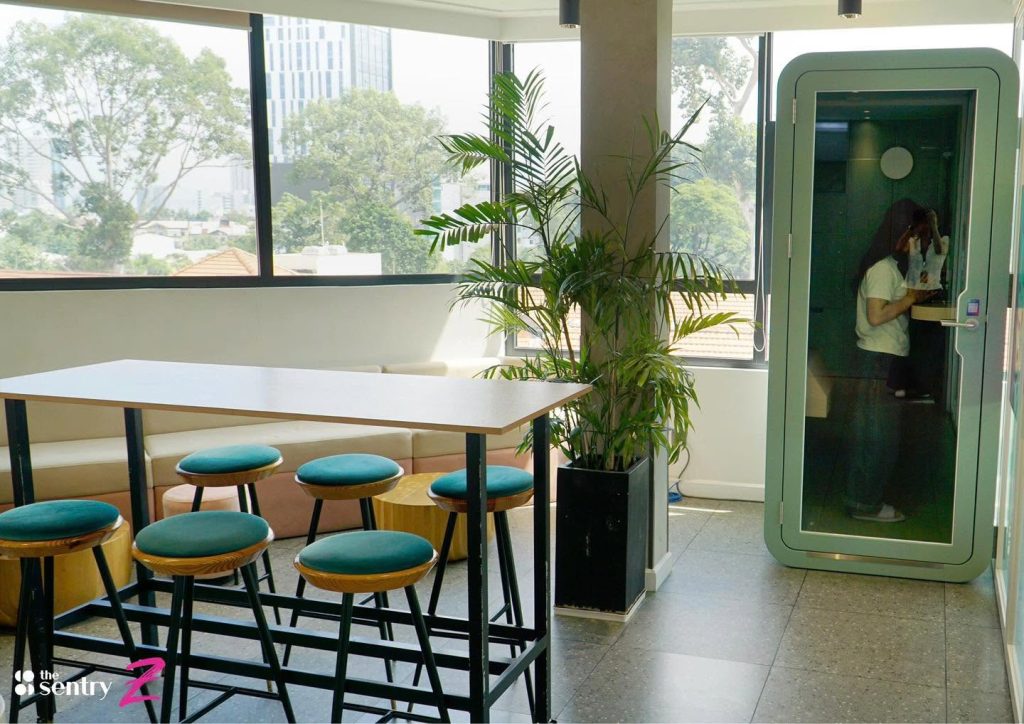
At 25A/1 Nguyen Binh Khiem Street, this eco-friendly hub is close to the Saigon Zoo and several consulates. More than half of the floor area is communal space, and the rooftop garden gives teams a calm spot to step away from the screen.
The Sentry Q and Orbital in District 12
Both sit inside Quang Trung Software Park, near the city’s tech talent pool. Software and engineering teams get workspace beside the people they plan to hire.
>>> Read more: Best Office Locations for Foreign Companies in Ho Chi Minh City
Book a Tour at The Sentry Today
Getting your tax obligations right starts with a base you can rely on. We offer foreign companies in Ho Chi Minh City a registered address, front-desk mail handling and flexible workspace that grows with your headcount. Book a tour today and see which Sentry location suits your team.
YOU MAY BE ALSO INTERESTED IN

Charter Capital in Vietnam: Minimum Requirements & Rules for Foreign Investors (2026)
Most companies in Vietnam face no fixed minimum for charter capital. You choose an amount that fits your business plan, then pay it in within 90 days of receiving your Enterprise Registration Certificate. Banks, insurers, and a handful of other regulated sectors do have set minimums, and foreign investors follow extra rules on how the […]

Corporate Taxes in Vietnam for Foreign Companies: CIT, VAT & Business License Tax (2026)
A foreign company that opens a Vietnamese subsidiary in 2026 picks up tax tasks almost immediately. There is a tax code to register, VAT invoices to issue, a provisional payment due by the 30th of the month after each quarter, and a withholding calculation every time an overseas consultant gets paid. The annual business license […]

Temporary Residence Card (TRC) in Vietnam: Requirements, Process & Validity (2026)
A Temporary Residence Card, or TRC, lets a foreigner live in Vietnam for up to 10 years without applying for a new visa each time. The card works in place of a visa, covers multiple entries, and usually comes back within five working days once your sponsor files a complete application. Investors, foreign employees, and […]

Interested in this location?
Complete the form below to book a tour or connect with one of our team members to find out more.