Vietnam Digital Nomad Visa & Long-Stay Options: What Remote Workers Need to Know (2026)

Vietnam has no digital nomad visa. That fact shapes almost every decision a remote worker makes here, so it comes first, before anything else. What Vietnam does have is a set of ordinary visa categories that remote workers combine to build a long stay, and this guide walks through which ones actually work, what each one costs, and where the legal lines sit in 2026.
Does Vietnam Have a Visa for Digital Nomads?
No, and nothing currently in front of the government would create one either.
Neighbouring countries such as Thailand and Malaysia have built dedicated remote work visas in recent years, but Vietnam’s immigration law still runs on the traditional categories: tourist, business, investor, labour, and a small set of special exemptions. Anyone who searches “Vietnam digital nomad visa” will find plenty of guides using that exact phrase, but every one of them is describing the same handful of workarounds covered below rather than a program built for remote workers specifically.

One recent change is unrelated to that core problem, but it affects who needs an e-visa at all. In August 2025 the government issued Resolution 229/NQ-CP, adding 12 European countries, including Belgium, Poland, and Switzerland, to the visa-free entry list for stays of up to 45 days. That visa exemption update only covers tourism, so it changes nothing about the legality of working while you are here. It just means citizens of those countries can skip the e-visa step for a short trip.
The 90-Day E-Visa Is Your Main Option
For most remote workers, the e-visa does the job.
It is open to citizens of more than 80 countries, runs for up to 90 days, and comes in single-entry or multiple-entry form.
Multiple entry costs roughly VND 1,300,000 (USD 50) against roughly VND 660,000 (USD 25) for single entry, and it is the version most digital nomads pick, since it lets you leave for a weekend in Bangkok or Phnom Penh and come straight back on the same visa rather than starting a fresh application.
How to Apply
The process runs entirely through the government’s own portal at evisa.gov.vn:
- Upload a scan of your passport’s photo page
- Upload a passport-style photo
- Pay the fee online by card
- Wait 3 to 5 working days for approval
- Save or print the PDF approval letter for arrival
No proof of income, onward travel, or accommodation is asked for anywhere in the form. Your passport needs at least six months of remaining validity and two blank pages, and the fee is non-refundable even if your application is rejected.
The Visa Run When It Expires
An e-visa cannot be extended from inside Vietnam. Once the 90 days run out, you leave the country and come back on a fresh one.
This routine, commonly called a visa run, is what most long-term remote workers in Vietnam plan their quarter around, often pairing it with a short trip to Cambodia, Thailand, or Laos.
Overstaying instead of leaving brings a fine starting at roughly VND 500,000 (USD 20) a day, and repeated overstays can lead to a period during which you are barred from returning, so it helps to put the expiry date somewhere you will actually see it.
>>> Read more: 6 Best Places for Digital Nomads in Vietnam
Business Visa (DN) for Longer Stays
If 90-day cycles start to wear thin, the DN business visa stretches a stay out to 12 months with multiple entries. It needs a sponsor letter from a registered Vietnamese company rather than a personal online application, which is the trade-off for the longer term.
There are two versions of the DN visa:
| Visa | Who it suits | What it allows |
| DN1 | Foreigners working with a Vietnamese company or organisation that sponsors them | Meetings, negotiations, short-term project work with that sponsor |
| DN2 | Foreigners offering services, setting up a company, or trading under an international agreement | Business setup activity, market research, service delivery |
A DN visa does not authorise employment, and it does not qualify you for a Temporary Residence Card, so treat it as a bridge rather than a long-term solution.
Some visa agencies advertise arranging DN sponsorship for a fee, which is risky, since a company nominally inviting you raises its own questions if authorities look closely later. Costs vary by agency and by embassy, but expect somewhere between VND 4,000,000 (USD 150) and VND 10,500,000 (USD 400) for a 12-month multiple-entry DN visa once the sponsor letter, embassy fee, and any agent charge are added together.
Processing at the embassy or consulate typically takes 3 to 5 working days once the approval letter arrives, and the whole chain from finding a sponsor to holding the visa in hand usually runs two to three weeks.

Other Long-Stay Routes: Investor and Talent Visas
Two further paths exist beyond the e-visa and the DN visa, and both suit a narrower group of people than most remote workers expect.
The Investor Visa (DT)
Setting up a Vietnamese company and applying for a DT investor visa is the route some long-term remote workers choose.
The entry-level DT4 tier covers a capital contribution under VND 3 billion (USD 114,000) and allows up to 12 months of stay, but it does not qualify for a residence card. Reaching DT3 status needs a contribution of VND 3 billion (USD 114,000) or more, and opens the door to a Temporary Residence Card.
That figure lines up with the exemption threshold that applies to company owners under Vietnam’s work permit rules, so anyone clearing it for a DT3 visa is often clearing a second bureaucratic hurdle at the same time.
Registering a limited liability company in Vietnam typically costs a few million dong (roughly USD 100 to 300) in government fees plus legal support, and takes a few weeks to complete. The capital contribution is what stops most people, since it has to be real money moved into the business rather than a figure written on a form, and DT4’s lower threshold makes it the more realistic entry point for a solo remote worker who wants a company structure without the DT3 commitment.
Talent Visa and the Golden Visa Rumours
Decree 221/2025/ND-CP created the Special Visa Exemption Card in August 2025, giving qualifying foreigners up to five years of multiple entry with a 90-day stay allowed per visit. The SVEC scheme targets senior executives, scientists, academics, and recognised artists rather than freelance remote workers, and nomination by a Vietnamese agency is part of the criteria.
A wider 10-year Golden Visa has circulated in Vietnamese media since 2025, but no legislation or application process exists for it yet, so it is not something to build a 2026 plan around.
>>> Read more: Vietnam Business Opportunities for Foreigners in 2026
Comparing Your Vietnam Digital Nomad Visa Options
Put side by side, the trade-offs between speed, cost, and length of stay become easier to weigh.
| Visa | Max stay | Needs a sponsor | Work for foreign clients | Leads to a residence card |
| E-visa | 90 days | No | Grey area, widely used | No |
| DN business visa | 12 months | Yes | No | No |
| DT4 investor visa | 12 months | No, own company | No | No |
| DT3+ investor visa | Longer term | No, own company | No | Yes |
| SVEC talent card | 5 years, 90 days per entry | Yes, by nomination | Limited, role-specific | No |
Staying on the Right Side of the Law
Vietnam’s immigration law treats remote work on a tourist or e-visa as a grey area rather than a clear yes or no, and it pays to understand where the risk sits before assuming the worst or the best.
Article 8.2 of the 2014 Law on Entry, Exit, Transit and Residence bars foreigners on tourist visas from labour activities, and the e-visa falls under the same framework, so the letter of the law is stricter than the everyday reality most remote workers experience.
What Counts as Work
Working online for a client or employer based outside Vietnam is tolerated in practice. Enforcement focuses on foreigners taking jobs from Vietnamese workers or working directly for Vietnamese companies without a permit, not on someone answering Slack messages for a company back home. Take on even one paid project for a Vietnamese client, though, and you trigger the work permit requirement, at which point the DN visa or e-visa stops being enough on its own.
Overstay and Illegal Work Penalties
Working for a Vietnamese company on a tourist visa or e-visa carries a fine of VND 15 to 25 million (USD 570 to 950) and can lead to deportation, while overstaying the visa itself is a separate offence fined at roughly VND 500,000 (USD 19) per day up to a cap, with repeated cases risking a longer entry ban on top of the fine.
Registering Your Stay
Anyone staying in private accommodation, rather than a hotel, needs their host or landlord to register their temporary residence with local police within 24 hours of arrival. Hotels and serviced apartments usually handle this step automatically, which is one reason many remote workers choose managed accommodation over a private rental for their first few weeks.
>>> Read more: Vietnam Apartments for Rent Monthly
Tax Residency and the 183-Day Rule
Vietnam decides tax residency by counting days, not by visa type.
Under Law 109/2025/QH15, which took effect in July 2026 alongside Decree 253/2026/ND-CP, a foreign national becomes a tax resident after 183 days of physical presence in a calendar year or in any rolling 12-month period, or by holding permanent or long-term rented accommodation in the country.
Cross that line and Vietnam taxes worldwide income at progressive rates running from 5 percent up to 35 percent. Stay under it and only Vietnamese-sourced income gets taxed, at a flat 20 percent.
In practice, enforcement lags well behind the law. Vietnam has no automatic exchange agreement that would flag a foreign freelancer’s overseas PayPal or Wise income to the tax authority, and most remote workers never register or file anything at all. That gap does not remove the legal obligation once the 183-day mark passes, and Vietnam’s tax treaties with more than 80 countries can reduce a double taxation problem for anyone who does want to file correctly.
Plenty of long-stay remote workers simply plan their visa runs to land under 183 days a year as a precaution rather than test the enforcement gap.
The risk profile differs depending on how you earn. A salaried employee whose company already withholds tax at home carries less exposure than a freelancer invoicing clients directly, since the freelancer has no employer filing anything on their behalf in either country.
If you expect to spend more than half the year in Vietnam across multiple stays, talking to an accountant who knows both your home country’s rules and Vietnam’s is worth the one-off cost, especially once income moves past a level where a mistake would actually matter.
>>> Read more: Vietnam Living Cost Per Month in 2024
Picking a Base in Vietnam
Where you spend your 90 days matters almost as much as which visa gets you there. Internet reliability, coworking density, and how many other foreigners are around all shift noticeably from one city to the next, so it helps to know the general shape of each option before booking a one-way flight.

Ho Chi Minh City
The largest city offers the deepest professional network, the widest choice of coworking spaces, and direct flights to most of Southeast Asia. District 1 and Thao Dien in District 2 are the two neighbourhoods most remote workers gravitate towards, for the mix of cafes, coworking options, and other foreigners doing the same thing.
Da Nang
A beach city with fast fibre internet and coworking rents starting around USD 80 a month, Da Nang draws a large remote work community and suits anyone who wants ocean access without giving up city conveniences.
Hoi An
A quieter pace suits people who want deep focus over networking. The ancient town’s UNESCO World Heritage status keeps development restrained, and a small coliving scene has grown up around it over the past couple of years.
Hanoi
Vietnam’s capital brings a cooler climate for part of the year and a different rhythm from the south, with an old quarter cafe culture that plenty of writers and developers prefer for long working sessions.
Phu Quoc
An island option for anyone who wants beach living without giving up an international airport nearby, though the coworking scene here is thinner than in the four cities above.
>>> Read more: Discover the Best Flats for Digital Nomads
Find Your Workspace in Ho Chi Minh City with The Sentry

If Ho Chi Minh City is where you land, you need somewhere to get work done once the sightseeing wears off. The Sentry runs coworking spaces and a co-living property across the city, built for exactly this kind of flexible, short-notice stay.
- The Sentry L, Le Thanh Ton Street, District 1. Co-living with furnished rooms and cleaning every three days, so you can land with a suitcase and start working within the week.
- The Sentry C, 15 Le Thanh Ton Street, District 1. Hot desks and day passes among Saigon’s tech and creative community, for anyone who wants company while they work.
- The Sentry P, 16 Nguyen Dang Giai Street, Thao Dien, District 2. The pick for remote workers based in the expat-heavy Thao Dien area, a short walk from Vincom Mega Mall.
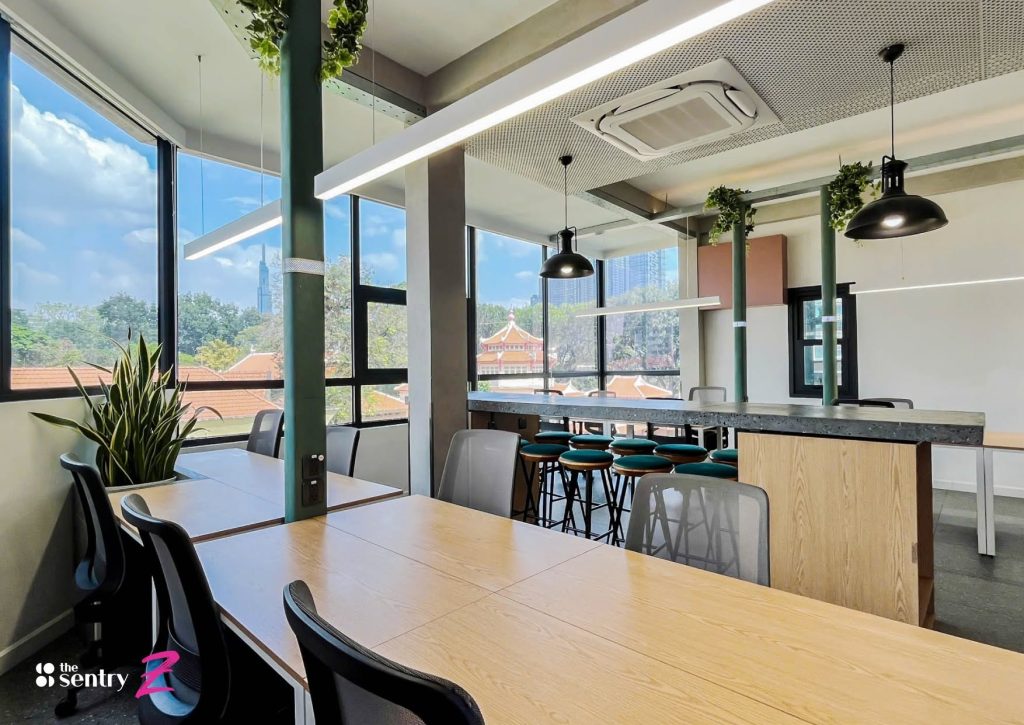
- The Sentry Z, 25 Nguyen Binh Khiem Street, District 1. Vietnam’s first Lotus Gold certified coworking building, with a rooftop garden for a change of scene between calls.
- The Sentry Q, inside Orbital 2.0 at QTSC IT Park, District 12. Suits anyone spending a longer stretch near the city’s tech and engineering community.
Day passes, hot desks, and monthly memberships are all available with no long-term contract, which fits a visa situation that rarely stretches past 90 days at a time.
Book a tour today and see which space fits how you want to work.
YOU MAY BE ALSO INTERESTED IN

Branch Office vs Representative Office in Vietnam: Which Should Foreign Companies Choose?
Foreign companies entering Vietnam usually run into the same question early on. Do you register a representative office or a branch office? The two structures look alike at first glance. Both let a foreign company operate under Vietnamese law without setting up a fully separate local entity. The similarities stop there once you look at […]

Best Coworking Spaces in District 2 & Thao Dien (2026)
District 2 and Thao Dien have become the go-to base for founders, freelancers, and remote teams who want a workspace close to where they actually live. The area sits across the river from downtown Saigon, but Metro Line 1 and a fast-growing business scene have turned it into a work hub in its own right. This […]

How Much Does a Serviced Office Cost in Ho Chi Minh City? 2026 Pricing Guide
Shopping for office space in Ho Chi Minh City usually comes down to one question: what is this actually going to cost? The answer depends on what kind of serviced office you pick, but most businesses end up paying somewhere between 1,500,000 VND and 15,000,000 VND per person each month. A hot desk sits at […]

Interested in this location?
Complete the form below to book a tour or connect with one of our team members to find out more.