Vietnam Digital Nomad Visa & Long-Stay Options: What Remote Workers Need to Know (2026)

Vietnam rewrote its rules for foreign workers in August 2025, and 2026 is the first full year those rules run end to end. Decree 219/2025/ND-CP replaced Decree 152/2020 and Decree 70/2023, folded two separate approvals into one online application, and gave the authorities a firm ten working day deadline to respond. A process that used to run five weeks now takes about three.
This Vietnam work permit guide for foreigners covers who needs a permit, what documents to gather, how the application runs in 2026, which categories are exempt, what it costs, and what happens after the permit arrives.
Who Needs a Work Permit to Work in Vietnam
Most foreigners taking a job in Vietnam need a work permit first. The requirement covers a wide range of situations: a formal labor contract, an internal transfer from an overseas office, a shorter service contract, or a role tied to a specific project. The government wants a record of who is working, for whom, and in what capacity.
A short business trip for meetings or a conference doesn’t fall into this list, since no employment relationship exists in Vietnam during that kind of visit.
Activities That Require a Work Permit
You’ll typically need one if you’re:
- Working under a Vietnamese labor contract
- Transferring internally from an overseas branch or parent company
- Delivering a service under a contract with a Vietnamese entity
- Setting up or running a commercial presence for a foreign company
- Sitting on the board or owning part of a company with capital under VND 3 billion
- Assigned to Vietnam by an overseas employer, outside of an intra-company transfer
- Volunteering in a formal capacity
- Working on a project or bidding package based in Vietnam
A handful of narrower cases apply too, including certain dependents of foreign diplomatic staff, but the list above covers the situations most incoming employees and business owners run into.
The Four Job Categories Vietnam Recognizes
Vietnam sorts foreign workers into four categories, and each one comes with its own bar to clear. The table below lays out what each requires and what you’ll typically need to prove it.
| Category | Core Requirement | Typical Proof |
| Manager | Runs a company or heads an agency or organization under Vietnamese law | Company charter, appointment decision, or business registration documents |
| Executive Director | Heads a branch, representative office, or business location, or manages a department with at least 3 years of relevant experience | Branch or rep office registration certificate, plus an employer letter confirming experience |
| Expert | A university degree plus 1 to 2 years of relevant experience depending on the sector, or 5 years of experience without a degree | Diplomas, transcripts, and confirmation letters from past employers |
| Technical Worker | At least 1 year of vocational training plus 2 years of experience, or 3 years of experience on its own | Training certificates and employer confirmation letters |
Experts and technicians working in finance, science, technology, innovation, or national digital transformation get a shorter experience requirement under the new decree, sometimes as little as 1 year with the right degree. Most foreign employees hired into an ordinary staff role, rather than a management or specialist position, still end up filed under Expert or Technical Worker, since Vietnam’s system doesn’t have a general all-purpose employee category the way some countries do.
>>> Read more: Best Office Locations for Foreign Companies in Ho Chi Minh City
What Changed Under Decree 219 in 2026
Check anything you read online against this table first. Guidance written before August 2025 will send you to the wrong office with the wrong forms.
| Item | Before August 2025 | Under Decree 219 |
| Job advertising | 15 days on a government portal | 5 days on any public platform, including your own site |
| Approval steps | Labour demand approval, then permit application | One combined dossier |
| Processing time | Around 5 weeks total | 10 working days from a complete file |
| Issuing authority | Department of Labour, with MoLISA for special cases | Provincial People’s Committees |
| Short-term exemption | Under 30 days per entry, 3 entries per year | Under 90 days total per calendar year |
| Exemption categories | 14 | 15 |
| Working in other provinces | Often a fresh permit | One permit covers multiple provinces |
The Job Advert Requirement Shrank
Advertise the vacancy for five days on any public platform, including your own careers page. Save a dated screenshot while the advert is live. Proof of the posting goes into the dossier, and reconstructing it afterwards is harder than it sounds.
One Dossier Instead of Two
You no longer apply twice. Approval for the hire and the permit application sit in one submission through the National Public Service Portal. If the worker has been residing in Vietnam, request the criminal record certificate in the same flow and skip the separate trip to the police department.
Provincial Committees Took Over Licensing
File with the Provincial People’s Committee, which may delegate the work to a specialised agency. If your company operates across several provinces, the committee covering your head office is the one that decides. Ignore any source telling you to file with MoLISA, which merged into the Ministry of Home Affairs in March 2025 and no longer exists under that name.
Ten Working Days, With Conditions
The ten days start when your file is complete, so treat completeness as the real deadline. One missing legalisation stamp or untranslated document puts you back at the end of the queue.
In Ho Chi Minh City you no longer collect anything in person. Since 15 June 2026 the Department of Home Affairs issues digitally signed work permits in place of paper documents.
One Permit, Several Provinces
List every intended workplace in your original application, because one permit now covers all of them. If a new site comes up later, notify the local authority at least three days before the employee starts there, giving name, nationality, passport number, permit number, and the dates involved.
Vietnam Work Permit Requirements for Foreigners

The personal conditions are short and have barely moved. The professional conditions are where Decree 219 loosened things considerably.
Personal Eligibility
- At least 18 years old and legally capable
- Health suitable for the job, certified by a licensed facility
- No current criminal sentence or pending prosecution under Vietnamese or foreign law
- A Vietnamese employer willing to sponsor the application
Manager and Executive Director Criteria
These two categories rest on corporate documents rather than years of experience. A manager is proven through the company charter, the appointment decision, and the business registration, while an executive director needs an appointment decision showing they head a unit and report to the manager. Neither carries a degree or experience threshold. Founders and senior transfers usually file here for that reason alone.
Expert and Technician Thresholds
The three-year experience floor that used to block younger specialists has come down.
| Category | Old rule | 2026 rule |
| Expert | Bachelor’s degree plus 3 years relevant experience | Bachelor’s degree plus 2 years relevant experience, or a related degree plus 1 year for priority sectors |
| Technical worker | 1 year training plus 3 years experience, or 5 years experience | 1 year training plus 2 years experience, or 3 years experience |
The one-year track applies to science, technology, innovation, national digital transformation, sectors flagged for development by ministries or provincial authorities, and fields covered by government cooperation agreements. Fintech, AI, and semiconductor teams benefit here, since they tend to recruit people two or three years out of university.
Employer Obligations
The employer carries the legal weight here. Before submitting, the company posts the vacancy publicly for at least five days, explains why the role needs a foreign hire, and holds valid business registration. Once the permit is granted, the employer and the worker sign a written labour contract before the start date and file a copy with the issuing authority.
>>> Read more: How to Set Up a Virtual Office in Vietnam for Founders and Growing Teams
Documents for a Vietnam Work Permit Application
The paperwork splits between the worker and the company. The worker’s side takes far longer, almost entirely because of legalisation.
The foreign worker supplies:
- Passport copy, notarised
- Health certificate from a licensed facility, issued within the last 12 months
- Criminal record certificate issued within the last 6 months, from Vietnam or the home country
- Degree certificates and professional qualifications
- Experience confirmation letters from previous employers
- Two 4x6cm photographs on a white background
The employer supplies:
- Application form under the current decree
- Written explanation of the demand for foreign labour
- Business registration certificate
- Job description and position details
- Draft labour contract, secondment letter, or appointment decision
- Proof of the job posting
Most applicants find it faster to get the Health Check Certificate done in Vietnam at a recognized hospital once they’ve arrived on a business visa, since a locally issued certificate skips the legalization step entirely. The same logic applies to the Criminal Record Certificate. Applying for it in Vietnam through the police authority, now routed through the same portal used for the work permit itself, often saves the mailing delay of requesting one from a home country.
Anything issued outside Vietnam, and in a language other than Vietnamese, needs consular legalization and a certified Vietnamese translation before submission. This step alone adds days to the timeline for applicants coming from countries where legalization queues run long, so starting early pays off.
How to Apply for a Work Permit, Step by Step
The application itself now runs in three stages.
Step 1: Post the Job
Employers post the position publicly at least 5 days before filing the application. This no longer has to go through a government labor portal specifically. A company careers page or a mainstream job board works, as long as the posting shows a real attempt to find a qualified Vietnamese candidate first.
Step 2: Submit the Combined Dossier
The employer files the full dossier, covering both the justification for hiring a foreigner and the work permit request, between 10 and 60 days before the worker’s expected start date. This runs through the National Public Service Portal, which also routes the Criminal Record Certificate request to the police authority at the same time. The licensing authority then has 10 working days to review the application and issue the permit or a written denial.
Step 3: Sign the Labor Contract
Once the permit comes through, the employer and the foreign worker sign a labor contract matching the terms in the permit application. A copy goes to the issuing authority on request. This step clears the worker to start.
Start to finish, the process now takes roughly 3 weeks in practice, though some provinces move faster or slower depending on their caseload.
Common Reasons Applications Get Rejected
A complete dossier doesn’t guarantee approval. Applications get turned down for a handful of recurring reasons:
- The applicant’s qualifications or experience don’t match the job category claimed
- The authority isn’t convinced the position needs a foreign hire at all, which tends to be the hardest point to argue
- The form is filled in incorrectly or missing a proper explanation for the hire
- Local policy varies from province to province, and what clears easily in one city can get extra scrutiny in another
Policies also shift over time. What worked for a similar hire last year isn’t guaranteed to clear the same way today, so it pays to check current requirements rather than assume last year’s approval sets a precedent.
Vietnam Work Permit Exemptions in 2026

Decree 219 lists 15 exemption categories in Article 7. Several of them cover people already living in Ho Chi Minh City who assume they need a permit.
These come up most often:
- Owners or members of an LLC, and chairpersons or board members of a JSC, who have contributed capital from VND 3 billion
- Managers, executives, experts, and technicians working under 90 days in total across a calendar year
- Foreign nationals married to a Vietnamese citizen and residing in Vietnam
- Heads of representative offices, and project heads of international organisations or foreign NGOs
- Foreign lawyers licensed under the Law on Lawyers, and journalists confirmed by the Ministry of Foreign Affairs
- Workers in finance, science, technology, innovation, and digital transformation, where central or provincial authorities confirm the sector as a priority
- Specialists entering for under three months to fix technical failures that local staff cannot resolve
- Family members of diplomatic mission staff, where a treaty permits them to work
The 90-Day Rule
Consultants and regional managers feel this change more than anyone. The old rule counted trips, capped at under 30 days each and three trips a year. The new one counts total days across the calendar year, from 1 January to 31 December. Nine two-week visits now sit inside the exemption, while a single four-month posting falls outside it and needs a full permit.
The VND 3 Billion Route
Roughly USD 117,000 in capital contribution puts a company owner or board member outside the permit regime. Founders setting up in Vietnam often structure their contribution with this threshold in mind, since clearing it removes an entire administrative track from the launch timeline.
Married to a Vietnamese Citizen
Foreign nationals married to a Vietnamese citizen and residing in Vietnam sit outside the permit regime. It is one of the more widely used exemptions in the city. The written confirmation is still required before work starts.
Priority Sectors Need a Confirmation Letter
The newest category covers finance, science, technology, innovation, and digital transformation. It applies only where central or provincial authorities have confirmed the sector as a priority, so the confirmation letter carries the exemption rather than the job title on the contract.
Short-Term Technical Fixes
Specialists flown in for under three months to resolve a technical or technological failure are exempt, on the basis that neither local staff nor foreign experts already in the country can handle it. The provision is drafted narrowly, and inspectors apply it the same way.
Exemption Still Means Paperwork
An exemption removes the permit and leaves the filing in place. Most exempt workers still need a written confirmation of exemption before they start. For the handful of categories that skip the confirmation, the employer notifies the authority no later than three working days before work begins, with details of the worker, the employer, and the assignment. Miss that notification and the penalties match those for working with no permit at all.
>>> Read more: Virtual Office in Ho Chi Minh City: Benefits, Costs & How to Choose
Validity, Renewal, and Re-issuance
A work permit lasts up to two years, and the exact term matches whichever document underpins it: the labour contract, the secondment letter, the international agreement, or the company’s operating licence. A contract that ends in 14 months produces a 14-month permit.
Renewal is allowed one time, for up to two more years, which gives most foreign workers a four-year runway before the full application starts again from scratch. Re-issuance handles smaller cases such as a lost or damaged permit, or a change of details on an existing one. Permits issued under the old decrees stay valid until they expire, and any renewal or re-issuance after that follows Decree 219.
Revocation costs you the permit and the residence card that depends on it. The authorities can withdraw either one on any of these grounds:
- The permit has expired
- The worker or employer used it for a purpose other than the one stated
- The worker faces criminal prosecution
- The employer has closed or ceased operations
- The sending organisation has withdrawn the assignment
What a Vietnam Work Permit Costs
Government fees are set by provincial People’s Councils and vary from place to place. Ho Chi Minh City charges around VND 600,000 for a new permit and VND 450,000 for a renewal or re-issuance. Hanoi has historically applied VND 400,000 for a new permit, and a handful of provinces sit closer to the VND 1,000,000 ceiling. Ask your provincial authority for the current figure before you budget.
The larger spend sits in the documents rather than the filing:
- Health check at a licensed hospital in Vietnam: VND 800,000 to 4,000,000
- Criminal record certificate obtained in Vietnam: VND 200,000
- Consular legalisation: around VND 250,000 per stamp, or VND 2,000,000 to VND 5,000,000 for a full police check processed abroad
- Notarised translation into Vietnamese: VND 200,000 to 500,000 per document
Companies using an agency should add service fees on top, usually in the USD 400 to 800 range per applicant.
After the Permit: LD2 Visa and Residence Card
A work permit sits inside a stack of four approvals: labour demand approval, the permit itself, the work visa, and the temporary residence card. Each one depends on the approval before it, so a delay in the first week pushes the last step back by the same margin.
Why Visa Type Matters More in 2026
Since early 2026, temporary residence cards are issued only to LD2 and TT visa holders. Anyone who entered on a DN1, VR, or e-visa now has to convert to the correct category before applying, which adds a step and a week or two to the end of the process.
Applying for the Temporary Residence Card
The residence card needs a work permit with at least 12 months left on it, and it runs for up to two years for LD2 holders. It replaces repeated visa extensions, and it makes ordinary things easier, such as opening a bank account or signing a lease in your own name.
Exempt Workers Take the LD1 Route
Foreign nationals holding a confirmation of exemption sit under LD1 rather than LD2. Dependents apply under TT.
>>> Read more: How to Choose a Coworking Space in HCMC
Penalties for Getting The Law Wrong
Vietnam does not issue warnings for this, and inspections in Ho Chi Minh City are routine.
- Worker without a valid permit: VND 15 to 25 million, plus deportation and a period of ineligibility to return
- Employer with 1 to 10 unpermitted workers: VND 30 to 45 million
- Employer with 11 to 20 unpermitted workers: VND 45 to 60 million
- Employer with 21 or more unpermitted workers: up to VND 75 million
Fines for organisations are calculated at double the individual rate under Decree 12/2022. A violation also sits on the company record, which is the part that complicates later applications.
What Is Coming Next
In May 2026 the Ministry of Home Affairs opened public consultation on a draft decree amending Decree 219. The proposals include accepting health certificates from qualified foreign medical institutions, removing experience requirements for finance and technology roles, integrating criminal record checks further, and widening exemptions for STEM professionals.
None of it is in force yet. If your hiring plan runs into late 2026, check the status before you build a timeline around the current rules.
Frequently Asked Questions
Do I need a work permit to work in Vietnam?
Yes, unless you fall into one of the 15 exemption categories in Article 7 of Decree 219. A tourist visa, business visa, or e-visa gives you the right to enter Vietnam and nothing more. Working without a permit or an exemption confirmation carries a fine of VND 15 to 25 million, deportation, and a period during which you cannot return. The employer is fined separately, at up to VND 75 million depending on how many unpermitted workers are found.
How long does a Vietnam work permit take in 2026?
Ten working days from a complete file. Preparing that file is the longer part, since legalising a foreign degree certificate and criminal record commonly takes four to six weeks. Plan on two to three months from the decision to start the date if the worker is still overseas.
How long is a Vietnam work permit valid?
Up to two years, matched to the length of the labour contract or assignment letter behind it, and you can renew once for up to two more years. After that a fresh application goes through the full process again. Diarise the renewal about 90 days before expiry, because a lapsed permit means starting over rather than extending.
How much does a Vietnam work permit cost?
The government fee is VND 600,000 in Ho Chi Minh City and VND 400,000 in Hanoi, with some provinces up near VND 1,000,000. Documents cost more than the fee. Budget VND 800,000 to 4,000,000 for the health check, VND 200,000 for a criminal record certificate issued in Vietnam, and USD 80 to 200 for a police check legalised abroad.
Can I apply for my own work permit?
No. The employer files the application and carries the legal responsibility for it. Your part is supplying personal documents that have been legalised and translated. Companies without a registered entity in Vietnam usually work through an employer of record.
Which document should I start first?
The criminal record certificate. It expires six months after issue and takes the longest to legalise, so anything you start ahead of it tends to burn the window. Keep scanned copies once documents come back legalised. Replacing one from abroad is slow and expensive.
Does my work permit cover a different employer or a different city?
A permit is tied to one employer, so moving companies means a new application filed by the new employer. Working in other provinces for the same employer is fine under Decree 219, as long as you either listed those locations in the original application or your employer notifies the local authority three days before you start there.
What counts toward the 90-day exemption?
Total days spent working in Vietnam between 1 January and 31 December, added across every trip. The old rule counted individual trips of under 30 days with a maximum of three per year, and that version no longer applies. Six weeks in March plus six weeks in September puts you at 84 days, still inside the exemption. Add a third six-week trip in November and you have crossed the line.
How do I know if my exemption actually applies?
Confirm it with the provincial authority before the worker starts, since interpretations vary between provinces and a wrong assumption draws the same penalty as no permit at all. Most exempt workers still need a written confirmation of exemption, and the ones who do not still need their employer to notify the authority three working days ahead.
>>> Read more: Hot Desk vs Dedicated Desk: How to Choose the Right One
Find Your Team a Workspace in Ho Chi Minh City at The Sentry

Once the permit process is underway, your team needs somewhere to sit. The Sentry runs flexible offices and coworking spaces across Ho Chi Minh City, home to more than 70 startups and established firms in technology, venture capital, finance, e-commerce, and media.
Choose the location that fits how your team works:
- SONATUS, 15 Le Thanh Ton Street, District 1. Global and Japanese design in the centre of the CBD, surrounded by consulates, corporate headquarters, and the Japanese business district.
- The Sentry C, 15 Le Thanh Ton Street, District 1. The original Sentry location and home to much of Saigon’s tech, venture capital, and creative community, with a members’ lounge that doubles as informal meeting space.
- The Sentry Z, 25 Nguyen Binh Khiem Street, District 1. Vietnam’s first coworking space to earn Lotus Gold certification from the Vietnam Green Building Council, built with more than 1.4 tonnes of recycled materials. Over half the floor area is communal, including a rooftop garden and a nap room.
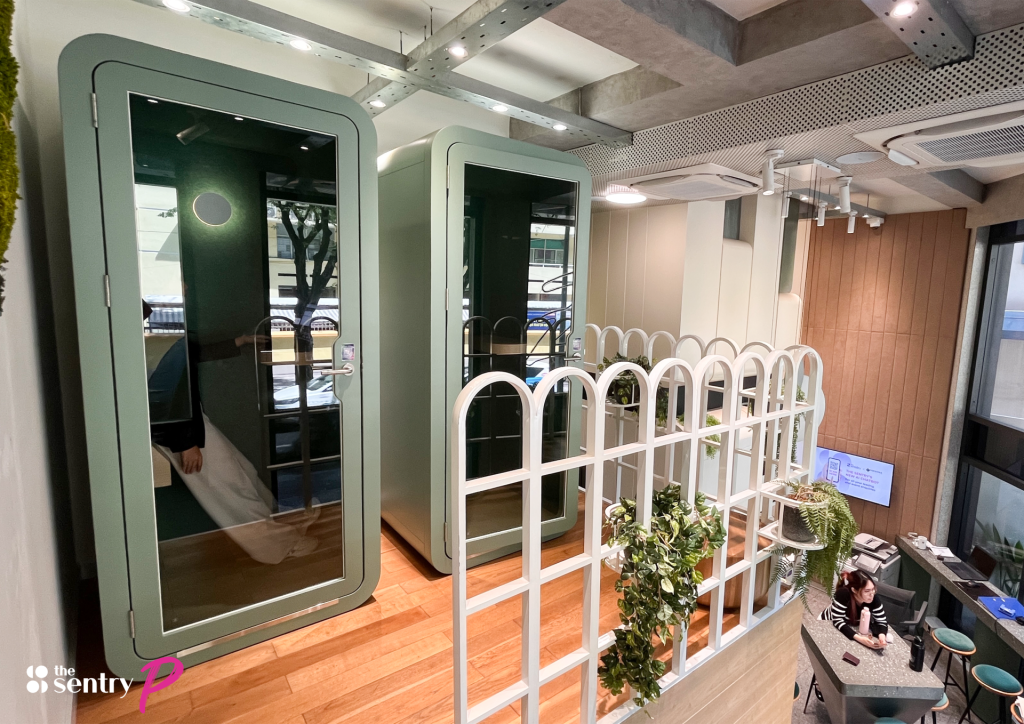
- The Sentry P, 16 Nguyen Dang Giai Street, Thao Dien, District 2. Opened in 2023 with a design-led layout, a short walk from Vincom Mega Mall, and the obvious pick for teams whose staff already live in Thao Dien.
- Orbital 1.0 and Orbital 2.0, QTSC IT Park, District 12. Campus-style buildings in Quang Trung Software City, where Orbital 2.0 offers 11,700 sqm across floors of roughly 1,465 sqm. QTSC houses over 20,000 technology workers and sits 15 minutes from Tan Son Nhat airport.
- The Sentry Q, inside Orbital 2.0 at QTSC IT Park, District 12. Three floors of coworking opened in December 2024, with dedicated desks, private offices, focus pods, meeting rooms, a training room, and an event space on the mezzanine.
- The Sentry L, Le Thanh Ton Street, District 1. Co-living for staff arriving before they have permanent housing, with furnished rooms, cleaning every three days, and access to The Sentry C lounge. Short and long stays both work when a start date moves.
Private offices, dedicated desks, hot desks, meeting rooms, and event spaces are available on flexible terms, with a member community that runs regular networking events.
Book a tour today and we will show you the spaces that suit your headcount and your budget.
YOU MAY BE ALSO INTERESTED IN

Branch Office vs Representative Office in Vietnam: Which Should Foreign Companies Choose?
Foreign companies entering Vietnam usually run into the same question early on. Do you register a representative office or a branch office? The two structures look alike at first glance. Both let a foreign company operate under Vietnamese law without setting up a fully separate local entity. The similarities stop there once you look at […]

Best Coworking Spaces in District 2 & Thao Dien (2026)
District 2 and Thao Dien have become the go-to base for founders, freelancers, and remote teams who want a workspace close to where they actually live. The area sits across the river from downtown Saigon, but Metro Line 1 and a fast-growing business scene have turned it into a work hub in its own right. This […]

How Much Does a Serviced Office Cost in Ho Chi Minh City? 2026 Pricing Guide
Shopping for office space in Ho Chi Minh City usually comes down to one question: what is this actually going to cost? The answer depends on what kind of serviced office you pick, but most businesses end up paying somewhere between 1,500,000 VND and 15,000,000 VND per person each month. A hot desk sits at […]

Interested in this location?
Complete the form below to book a tour or connect with one of our team members to find out more.